3D Motion Graphics: How They Are Made
and Where They Pay Off
At Productions Arborescence INC., 3D animation graphics are moving images built from three-dimensional models rather than flat drawings. Producing them takes five stages: modelling, texturing, rigging, animation and rendering. Businesses choose 3D over 2D when a product, a machine or a process has to be seen from every angle, in motion.
Do you know what separates a flat animated logo from a product that turns, opens and lights up on screen? The answer sits in how the image is built. 3D animation graphics start from a digital object with volume, not from a drawing. This guide covers what they are, how they are produced, how they compare with 2D animation, and where they earn their budget.
What Are 3D Motion Graphics?
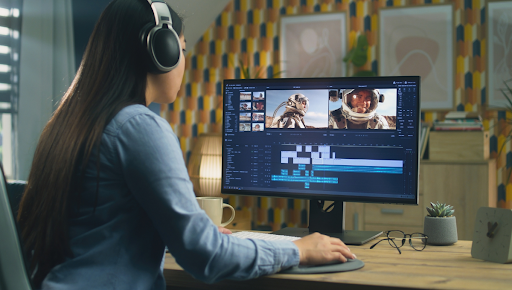
3D animation graphics are a branch of computer graphics: sequences of images generated from three-dimensional models, then played back at 24 frames per second or more to create movement. Unlike vector graphics, which stay flat, each object holds volume, surface and position in a virtual space, so a camera can move around it.
That difference changes what you can show. A 2D asset has to be redrawn for every new angle, while a 3D model is simply re-shot inside the software. Our graphic animation studio in Montreal works in both, and the choice comes down to how much the object matters to the message.
The Five Stages of a 3D Animation Project
Every project follows the same production line, whether the final clip runs 15 seconds or three minutes
- Modelling: an artist builds the object as a mesh of polygons, the digital equivalent of sculpting
- Texturing: colours, materials and surface detail are applied so plastic reads as plastic and steel as steel
- Rigging: a skeleton is added inside the model so it can bend and move without deforming
- Animation: the animator sets keyframes, the positions the software interpolates between to produce motion
- Rendering: each frame is calculated into a final image, the slowest stage by a wide margin
Animation software such as Autodesk Maya and Adobe After Effects covers these stages, and real time previews now cut the guesswork before a full render.
Do you want to make a professional-quality video?
Assign your project to us now.

2D Animation or 3D: Which One Fits Your Project
The decision rarely comes down to taste. It comes down to what the viewer needs to understand
| Criterion | 2D animation | 3D animation graphics |
| Best use | Explaining an idea or process | Showing an object or a space |
| Source asset | Vector illustrations | Textured 3D models |
| Camera movement | Simulated, redrawn per angle | Free, any angle from one model |
| Late revisions | Often means redrawing | Usually a re-render |
| Reuse across formats | Moderate | High, one scene, many outputs |
Our recommendation: choose 2D animation or motion design when the message is conceptual, and 3D art when the product, machine or building is the message.
Where 3D Motion Graphics Deliver the Most Value
Three-dimensional work earns its budget when the subject cannot be filmed, or cannot be filmed clearly
- Product demonstrations that open a device and show its inside
- Technical processes in manufacturing, transport or pharmaceuticals
- Architectural and spatial projects, including immersive virtual reality walkthroughs
- Data and process visualization for corporate and institutional communication
Productions Arborescence has produced video and animation work for VIA Rail Canada, Keurig, Barilla and Espace pour la vie. You can see the range in our animation projects, and the finishing happens in the same video post-production services we run in house.

Bring Your Next 3D Animation Project to Montreal
Productions Arborescence has been building animation and video for more than 15 years, from our studio on Peel Street, with Adobe Certified Expert credentials. If you have a product, a process or a space that deserves to be seen in motion, our team can scope it with you: start my animation project. You can also explore our promotional and advertising video work.
FAQ about 3D Motion Graphics
Timelines depend on three things: the number of models to build, the level of detail requested, and how many revision rounds you plan. 3D rendering time also scales with detail.
Yes, in most cases. The model needs clean geometry and a reasonable polygon count, and it usually has to be rigged before it can move convincingly.
They do, and the reuse is the advantage. One scene can be re-rendered in vertical, square and wide formats, in real time engines, without rebuilding a single model.
Key Points to Remember
- Five stages: modelling, texturing, rigging, animation, rendering
- 2D suits ideas, 3D suits objects and spaces
- One scene, many output formats
- Rendering drives most of the schedule